Description
Positive Features of the Cordless Rotary Hammer
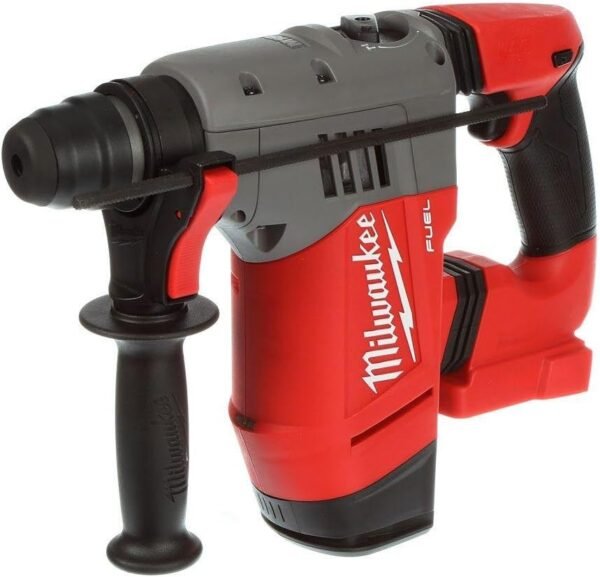
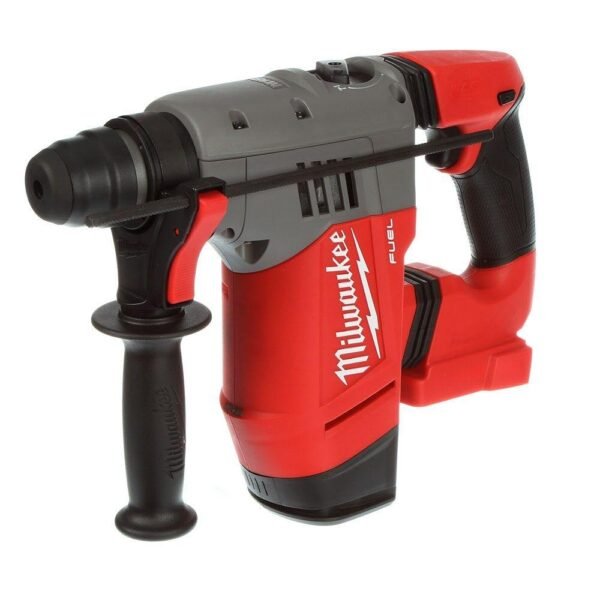
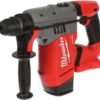
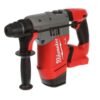
This cordless rotary hammer runs on Milwaukee’s 18-volt lithium-ion battery system, which is the whole point of the tool: SDS Max capability with nothing trailing behind it. The brushless motor is the enabling technology, running cooler and drawing less from the pack than a brushed equivalent, which is what makes a cordless tool at this power level practical rather than merely possible. The listed maximum impact energy of 5.0 ft-lb and blows per minute reaching up to 3000 put it firmly in concrete and masonry territory rather than general drilling. The SDS Max chuck is the right fitting for that work, taking large bits without a key and holding them under load.
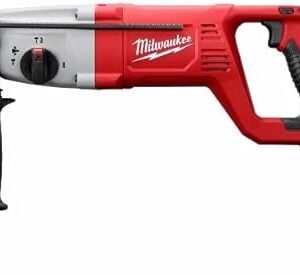
The D-handle design keeps the operator’s push in line with the bit, which is what gives control on a tool of this size. At a listed weight of about 12.2 pounds it is substantial, though the mass is distributed along the axis of the tool rather than hanging off it. Variable speed control from 0 to 450 RPM covers everything from a careful start to full output, and capacity runs to 1 9/16 inches in solid concrete with core bits up to 4 inches, which is a serious range for a battery tool.
- Brushless motor for efficiency and durability
- High impact energy suitable for concrete drilling
- Comfortable D-handle grip for control
- SDS Max chuck for easy bit changes
Limitations to Consider
There are real gaps to weigh. The absence of a battery and charger in the package means an additional outlay unless Milwaukee 18V packs are already in the van, and on a tool this power-hungry the packs are not the cheap part. The other significant omission is the lack of a rotation stop feature, which rules out chiseling: without it the bit cannot be locked against rotation, so demolition work needs a second tool such as the 5446-21 SDS Max demolition hammer.
The weight is well distributed but still 12 pounds, which tells during sustained overhead work. Noise is lower than many corded equivalents yet still demands hearing protection over any real period. The price is defensible given the build and the brushless drivetrain, though it is a lot to justify for occasional use.
- Battery and charger not included
- No rotation stop for chiseling
- Heavier than some competitors
- Requires hearing protection due to noise
Build Quality and Ergonomics
The glass-filled nylon construction is the standard answer for tools that get dropped on concrete: it takes impact without adding the weight of a metal housing. Milwaukee’s build reputation rests on details like this rather than on any single headline figure. The red color scheme is not merely branding either, since a tool that stands out in a cluttered box or a dusty room is a tool less often left behind.
The D-handle design is the ergonomic centerpiece, providing stability and reducing the wrist strain that comes from fighting a tool sideways in hard material. The length of 18 3/4 inches is short enough for confined work while leaving enough body to give leverage, which is the compromise every SDS Max tool has to strike.
Performance Across Different Tasks
The tool is aimed at drilling through concrete, masonry, and stone, and the listing pairs its 800-watt power figure with a high impact rate to make that case. Across a range of bit sizes, the specification supports steady progress rather than the stall-and-restart cycle that afflicts underpowered hammers. The variable speed dial is what keeps the tool matched to the material instead of running flat out at everything.
For light work or drilling wood, this is far more tool than the job needs, and an ordinary drill will be quicker and easier. The no-load RPM of up to 450 is low against lighter rotary hammers, which is the direct trade for high impact energy. Anyone whose work sits mostly below one inch will be better served by an SDS Plus tool such as the M18 Fuel SDS Plus hammer.
Value Proposition
Judged on features and build, this hammer represents solid value for money. Its portability is the differentiator, removing the generator and extension lead from jobs where power is not laid on, and that alone changes what can be done on a site. Battery compatibility across the Milwaukee range is the other half of the argument for professionals working concrete and masonry regularly.
For anyone who already owns M18 packs, this is a straightforward addition to the collection. Starting from nothing, the separate battery purchase alters the arithmetic considerably, and the kitted M18 Fuel SDS Max option is the fairer comparison, since it arrives ready to work.
Product Comparisons
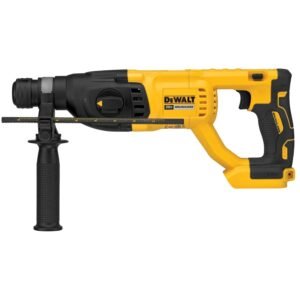
Against cordless rotary hammers from DeWalt and Bosch, this model competes on impact energy and construction. The SDS Max chuck is the notable specification, since many rivals at similar prices use SDS Plus, which caps bit size well below what this tool accepts. The counterpoint is that several DeWalt models include a rotation stop for chiseling, genuine versatility this one does not offer.
Bosch tends to publish higher RPM figures with lower impact energy, a different balance that suits faster drilling in lighter material, and the corded Bosch 11264EVS shows what the same money buys with a cord attached. This Milwaukee is oriented toward heavy work rather than general purpose, and its weight and noise levels are typical of that class. On handling, the D-handle and balance give it the edge for long sessions.
Features and Settings Overview
The core specification is a brushless motor, which means longer tool life and less maintenance, and variable speed control for adapting to material. Impact energy is fixed rather than adjustable, with the emphasis on sustained blows per minute. The SDS Max chuck accepts a wide bit range including large core bits, which is what makes it viable for construction and light demolition.
The tool does not include a rotation lock, so chiseling is out of scope. It ships with an instruction guide but no batteries or charger. The length and weight land between power and usability, heavier than compact tools built for overhead work, lighter than a corded breaker. The full rotary hammer category makes that positioning clearer.
User Experience and Practical Insights
In practical terms this is a tool for people who drill concrete often enough to want the cord gone. Power delivery is consistent by design, bit changes through the SDS Max system are quick, and the missing rotation stop is the one limitation that will send an owner back to a second tool. Anyone new to hammers of this size should expect a short adjustment period before the technique of letting the tool do the work becomes second nature.
Buying it bare only makes sense alongside an existing M18 battery collection, since swapping packs mid-job is what keeps the tool working. Noise and vibration at this power level call for gloves and ear protection as a matter of course. Judged on specification, it is a dependable option for serious concrete and masonry work.
The Milwaukee cordless rotary hammer 2717-20 combines power, portability and durability, with clear trade-offs in the missing rotation stop and the battery sold separately. For professionals and regular users who want brushless motor technology, SDS Max chuck versatility, and strong impact energy, the specification stands up, particularly on heavy-duty work.