Description
Powerful Motor and Versatile Speed Settings
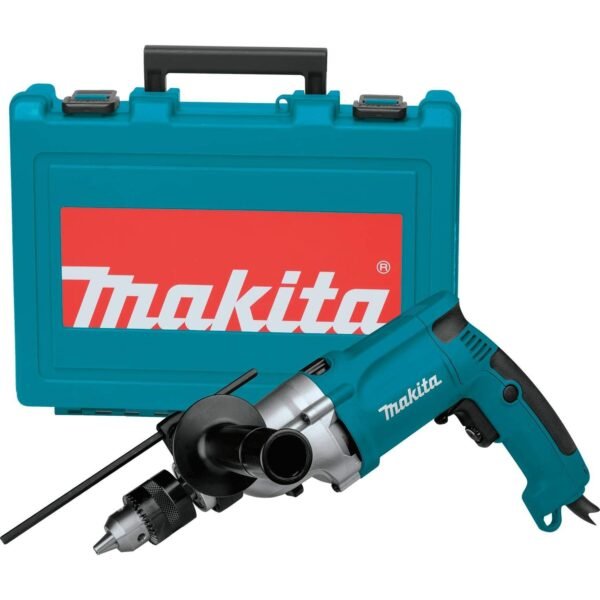
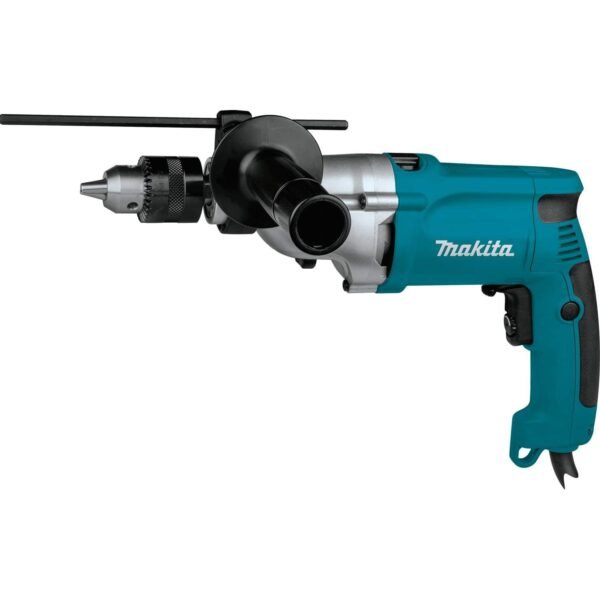
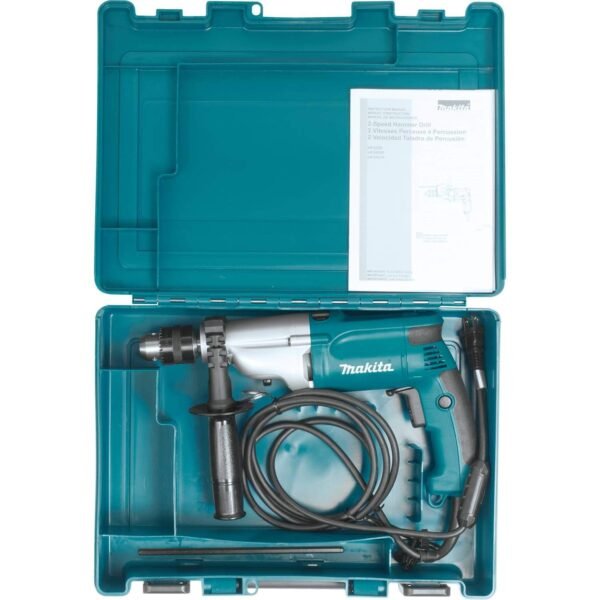
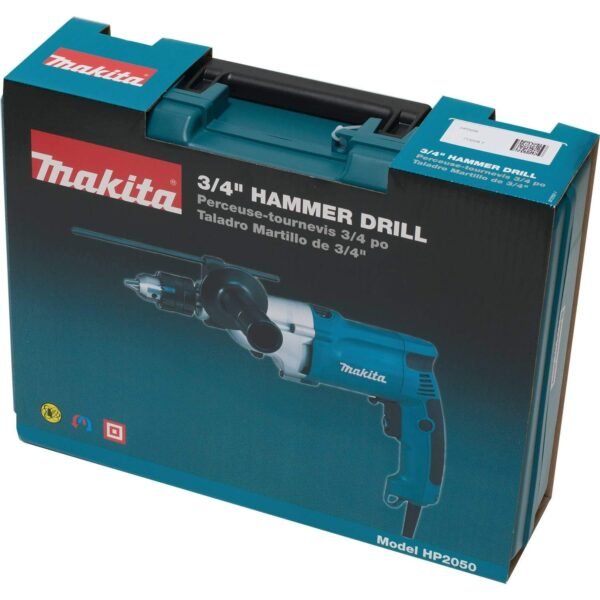
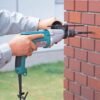
The Makita HP2050-R 6.6 Amp 3/4 in. Hammer Drill with Case is built around a 6.6 amp motor that holds up in demanding drilling. The spec sheet lists up to 530 inch-pounds of torque and a maximum rotational speed of 2,900 RPM, a pairing that puts real work within reach without stepping up to a rotary hammer. The variable 2-speed control is the feature that makes those numbers usable, separating 0 to 1,200 RPM for precision from 0 to 2,900 RPM for heavy-duty work. The variable speed dial smooths the transition, which is what allows the same tool to move between delicate wood work and masonry drilling, and fewer tool changes means less time lost.
Dual-Mode Operation and Built-In Clutch
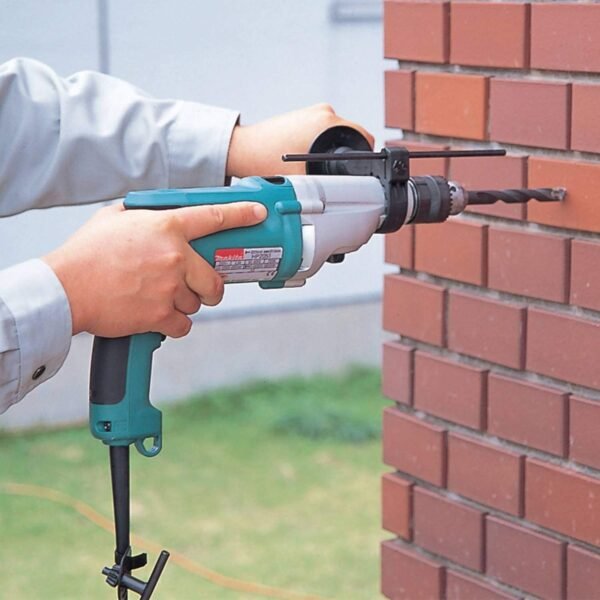
The two-mode operation, “Rotation Only” and “Hammering with Rotation”, is the other half of that flexibility, turning one tool into a conventional drill or a hammer drill as the job requires. The built-in clutch is the protective feature behind both modes, disengaging automatically when a bit binds so the gears are not the component that absorbs the shock. Bit binding is a routine hazard in metal and reinforced concrete, and a clutch is what separates a stalled drill from a damaged one.
Robust Chuck and Durable Design
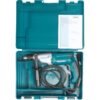
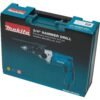
One point of care with the listing: the 3/4 inch figure in the product name is a capacity rating rather than the chuck opening, and the two are conflated in the description, so anyone planning to use large shank bits should confirm the actual chuck size with the manufacturer before ordering. What is clear is that the chuck itself is solid, holding bits firmly and resisting the slippage that ruins accuracy on harder material. The teal plastic exterior is sturdy while keeping weight down to 5.5 pounds (2.5 kg), which is light enough that overhead and confined work does not become a test of endurance. Where the job calls for larger holes in concrete than this class of drill is designed for, an SDS Plus tool such as the Makita HR4002 is the right tool rather than a bigger bit in this one. The included carrying case makes storage and transport straightforward for anyone moving between sites.
Highlights
- Powerful 6.6 AMP motor handles demanding applications comfortably.
- Two-speed variable control for precise and high-speed drilling.
- Built-in clutch protects the gears when a bit binds.
- Positive stop mode selector prevents accidental mode changes.
- Generous chuck capacity holds a wide range of drill bits securely.
Limitations
- The weight is well balanced but still feels substantial to anyone unused to power tools.
- Corded design limits mobility next to cordless models and requires an outlet.
- The plastic casing is durable without matching the premium feel of higher-end drills.
- Noise levels are high in hammer mode, so hearing protection is necessary rather than optional.
User-Friendly Features and Practicality
The positive stop mode selector is a small piece of design that prevents an irritating problem, namely switching between hammer and rotation modes by accident mid task. The variable speed control earns similar credit for letting speed be matched to the material, which is safer on delicate surfaces and more efficient on tough ones. The two-speed gearbox adds a further layer of control that simpler drills leave out, since a gearbox changes torque, not just speed. Taken together, these are choices aimed at a professional or a committed DIYer rather than at an occasional user buying on price.
Price Worthiness Compared to Its Features
On value, this hammer drill offers a solid balance of power, durability and useful features at a sensible price. It lacks the conveniences of the newest cordless tools, but the power and reliability of a corded machine remain a real advantage: mains power does not fade at the end of a long run. For anyone who wants consistent output without managing batteries, that is the whole argument. Durability and clutch protection extend the working life, which improves the cost per year rather than just the price on the shelf. Buyers who value freedom of movement more than constant power should weigh a cordless model such as the Makita XPH12Z instead, remembering that batteries and a charger are extra. The included carrying case is a genuine addition, since it keeps the tool and its accessories together.
Other Options and Competitive Landscape
Compared with hammer drills like the DeWalt DWD520K and the Bosch 11255VSR, this model leads on torque and durability for heavy-duty tasks while giving up portability to its cord. DeWalt’s corded drills, such as the DW130V, are lighter and better suited to quick jobs around the house, though they do not match the torque or offer the built-in clutch safety feature. Bosch counters with better ergonomics and quieter running, with less chuck capacity as the trade. The summary is straightforward: this drill suits buyers who put raw power and reliability ahead of convenience.
Practical Experience and Real-World Use
For less experienced users, the variable speed dial is the most approachable control on the tool, though the weight takes some getting used to and is the most common reason a corded drill feels harder to handle than expected. Anyone in that position who mainly drives screws and drills pilot holes may be better served by a compact cordless model like the Milwaukee M12 Fuel hammer drill. For woodworking and general shop use, the ability to drill wood and metal without switching tools is the practical benefit, and the carrying case keeps the drill and its accessories together between projects. The cord remains the recurring constraint on larger sites, where an extension becomes part of the setup rather than an occasional need.
Positive Features That Stood Out
- The built-in clutch protects the tool exactly when a bit catches.
- Variable speed control supplies precision and power on demand.
- Generous chuck capacity covers a wide range of drill bits.
- Durable construction with a robust motor for tough applications.
Drawbacks Worth Noting
- The corded setup means no freedom to roam without extension cords.
- The weight tires users out after prolonged sessions.
- Noise output is loud, especially in hammer mode.
- Plastic housing feels less premium than some competitors.
The HP2050-R reads as a dependable workhorse, capable across a wide range of drilling and hammering tasks. It has clear shortcomings, but the strengths outweigh them for serious users who want power, control and durability without complication, and it stands up well among the hammer drills in this price bracket.